

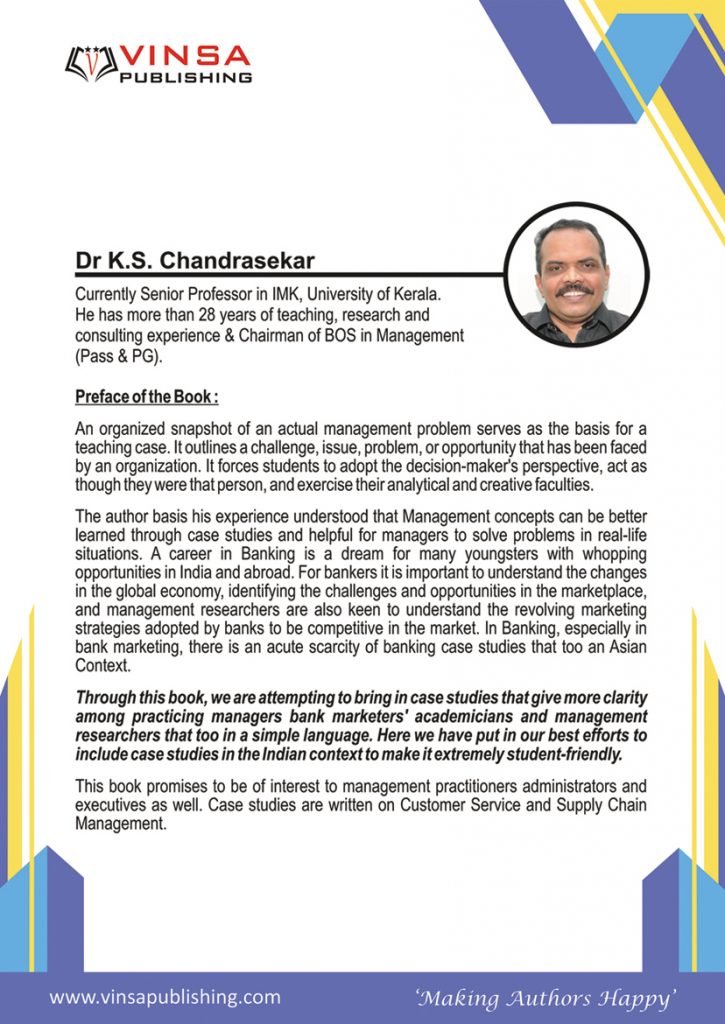
Prof.K.S.Chandrasekar is currently Senior Professor, IMK, University of Kerala, Trivandrum. He has more than 28 years of teaching, research and consulting experience and Chairman of BOS in Management (Pass & PG).
He holds B.Pharm (Hons) from BITS, Pilani, MBA with distinction from BSMED, Bharathiar University, Coimbatore and PhD in Management from Alagappa University, Karaikudi. He also completed one year CPET from Indian School of Business, Hyderabad. He has contributed more than Rs.157 Crore through funding from Government of Kerala, DST, UGC, AICTE, SBI, KILE etc. He held the post of Vice Chairman of Centre for Management Development, Government of Kerala for three years. He was formerly Registrar and Acting Vice Chancellor of University of Kerala.
Held the post of Dean, Faculty of Management studies for eight years in University of Kerala and currently Chairman –BOS in Management (PG), MG University. He held the post of Campus Director, University of Kerala for three years. Has more than 13 years experience as a Full Professor of University of Kerala and 10 years as Head of IMK, 63 scholars have completed Ph.D. under his guidance. Fellow of Centre for Education Growth and Research, New delhi and MTC Global, Bangalore. He has published 10 leading management books and 215 scholarly articles. Widely travelled across the world, he has chaired and presented papers in international and national seminars and also acting as NAAC peer team member. He is also a qualified umpire in Cricket tournaments. He was involved in structuring many innovative PG management programmes like Pharmaceutical management, Public health and hospital management, Energy management etc.
- He has won many awards like:
- “Top Ten Thinkers:2023”, MTC Global, January 2023
- “IQAC Leadership Award”, IQAC, Vadodara, January 2022
- “Distinguished alumni award”, BSMED, Bharathiar University, 2019
- “Best academic excellence”, Higher Education Forum, 2018
- Dewang Mehta Best Professor in Management, 2018
- MTC Global “Outstanding achievement in Management Education” award, 2017.
- Outstanding Ph.D guide award, AIMS-IRMA, 2016 at MICA, Ahmedabad
- SMART Journal Life time achievement Award, Bharathidasan University, Trichy, 2015
- Shri P.K.Das memorial Life time Achievement Award (Management), 2013, Nehru Group of Institutions, Coimbatore, 15th December 2013 with a trophy, certificate and Cash award of Rs.25000.
- “Asia’s Best Professor in Marketing Management”, CMO Asia, SUNTEC, Singapore, 22nd July 2011
- Best Academic of the Year 2008, Amity University
- Gold medal winner and awarded the Best Business Academic of the year 2006, Indian Commerce Association, Andhra University, Vizag.
The aim of this case study book is to support the student community in maximizing case study-based learning.
For business case writers, bridging the gap between academic learning and the workplace, where business decisions are made for a variety of problems, has never been easy.
In the modern management era, case-based teaching is advised rather than the traditional classroom teaching method because it can maximize student participation, which is crucial especially in management education.
Benefits of Case-based teaching
It is entirely possible for students to take part in the conventional lectures that educational institutions offer, and the study materials offered will identify the theoretical concept as well as some issues that managers of organizations in the competitive market face.
Although the theory might be able to pinpoint the management skills that are necessary, it won’t provide them with the practical knowledge they need to hone those skills.
Case studies give learners the opportunity to put what they have learned into practice, as well as to use their decision-making skills to achieve the same goal and suggest alternative courses of action. The learner must apply what he or she has learned theoretically in order to acquire these skills. A case study is typically based on real-world business circumstances or a made-up scenario that attempts to explain a business circumstance.
When using a case-based approach to teaching, the majority of students who had previously received instruction using the traditional method would have noticed a significant change in their learning strategies. However, it’s likely that the learner will offer a number of different approaches to solving the problem, each with a convincing justification. Therefore, the case study approach does not have a suitable response.
The student or learner is expected to put themselves in the position of the decision-maker facing the situation as they are studying the case studies and to offer a solution that could end the case.
The classroom case discussion
Depending on the tutor’s preference, the cases may be presented for discussion to either individuals or small groups. The interaction between the students during the case presentation should be fruitful and beneficial for enhancing both their interpersonal and communication abilities. Each person who spoke during the discussion should have had something to say that was pertinent to the situation. Discussions of hypothetical cases will only be fruitful if all participants have already prepared their case analyses.
Expectation from the learner
* To make the discussion meaningful, read the case carefully and comprehend the main issues raised.
* Name the main points raised.
* Create a plan of action with workable alternatives and how it will be carried out.
* Determine the best course of action after weighing the available options.
Expectation from the tutor
* Encourage the students to conduct a logical and creative analysis of the issues raised in the case.
*Ask students random questions to get an understanding of their opinions and ideas and then encourage sharing with other groups or students in the classroom.
* Act as a mediator between various groups or individuals while one group or individual presents the case, and then permit other groups or individuals to ask questions.
Presenting the Case
The instructor can decide whether to have oral or written presentations. After analyzing the given case, the learners are expected to identify, clarify, and recommend a better course of action in an oral presentation. Subsequently, the methodology used to analyze the case and the key concepts and tools used for analysis can be explained. It is ideal to give a chance to speak to each member of the team during a group presentation. It’s always a good idea to use visual aids like PowerPoint presentations, advertisements, newspaper clippings, and significant information related to the case. The case presentation must be completed within the time allotted by the instructor. Mention the main points and the future course of action based on the analysis during written presentations. The industry or organization that will be discussed in the case along with the major problems, goals, etc. can be briefly introduced in the report, aside from the overall analysis and key analytical concepts/tools (ideally to draw conclusions from each model applied). The report can be made more valuable by using charts, tables, and diagrams related to the case.
Usage of theoretical concept
The learner would be in a better position to explain the case and the reasoning behind using the tools used if they were to do so using theoretical concepts and frameworks. It should be noted that not every tool or model is applicable in every situation.
Conclusion
There are no right or wrong answers in this case. The learners are expected to develop a structured problem-solving decision-making process through case study-based learning. For aspiring researchers and managers, case studies are a boon to sharpen management abilities.
It is anticipated that the learners’ acquired skills will enable them to handle upcoming management challenges once they are employed. The learner would benefit greatly from applying their newly acquired knowledge to current business issues.